Showing posts with label Forgotten twentieth century figures. Show all posts

Monday, January 23, 2012

The Exiles


Irving Penn

"If one lives in exile, the café becomes at once the family home, the nation, church and parliament, a desert and a place of pilgrimage, cradle of illusions and their cemetery... In exile, the café is the one place where life goes on."

Hermann Kesten

I have always loved this quote as it rings so true, especially in France. Hermann Kesten was referring to the many German and Austrian writers, artists, intellectuals, political opponents, etc. Who with the rise of Hitler in the early thirties, left Germany and settled in France.

When France declared war on Germany in September 1939 German exiles were considered enemy aliens and interned in hastily constructed camps and prisons whilst they waited to have their cases heard and hopefully be released, this process took some time, if it happened at all.  In the meantime they lived  in appalling conditions with disease running rife, a few of them did manage to escape. By June 1940 the Nazis had marched into France and occupied Paris.  An armistice was signed and France was divided into two, German occupied France and Vichy France under the rule of the elderly Marchal Petain. The truth is both were very dangerous places to be and many French found themselves exiles in their own country.


 As the Nazis were marching towards Paris, thousands were trying to flee the capital, by any means, trains were full to bursting, all roads out of Paris were clogged, vehicles were abandoned when they ran out of fuel, thousands of people slept rough in barns and fields, there was no news but many rumours which added to the sense of panic, it was chaos.  Many were heading to the south or to the coasts, to try and get boats out or simply to stay with family or friends as far away from the Nazis as they could get, some had no clue where they were going, they just knew they had to leave.

Hitler put pressure on the Vichy government to round up all the German, Austrian and Czechoslovakian exiles, these people were now in grave danger, if they fell into the hands of the Gestapo they were imprisoned, sent to concentration camps or murdered by firing squads. Now thousands of French nationals also found themselves in danger, French artists, poets, writers and intellectuals were at particular risk, many of them were no longer in possession of the correct identity papers, trying to obtain the correct papers could result in arrest, they were aware they were on Hitler's list, many of them headed South to Marseilles where they shrank into the shadows, stayed in shabby back street hotels and met up with each other at the cafés, always looking over their shoulders.  They were now people without a state or a homeland, they had become in effect refugees. They needed a way out.

 Film Still from Casablanca

A Real Rick, Varian Fry

 Meanwhile in New York 'The Emergency Rescue Committee' had been set up, they had compiled a list of around 200 artists, writers and intellectuals who they considered to be at risk in occupied Europe, the list included Picasso, Matisse, Chagall, Andre Breton, Max Ernst and Marcel Duchamp, the objective was to help them to escape. 

  Havard graduate and political activist Varian Fry was the man who was chosen to go to Vichy France to set up an organisation to help people escape, in fact he was the perfect choice, he was a man with a strong social conscience, he was an intellectual who had studied the classics and he spoke French and German.  He arrived in Marseilles on August 14th 1940 with a suitcase, sleeping bag and air mattress, $3000 taped to his leg and a list of around 200 names.  His return flight to New York had been booked for August 29th.  He had around two weeks to get the job done!

Varian Fry, Andre Breton, Andre Masson, Jacqueline Lamba and Max Ernst at the CAS office.

Fry set up his organisation which he named: CENTRE AMERICAN DE SECOURS, 'CAS'.  The Tom tom drums had been beating and word got out on the refugee grapevine, that a man had been sent from America to help, he soon had a long line of people queuing outside his hotel room, it was not long before he had to find an office and trustworthy staff. 

Eventually he cobbled together an excellent team including a young American art student who had formerly been studying at the Sorbonne, Miriam Davenport.  Varian desperately needed more funding, help soon came from the beautiful, thrill seeking American heiress, Mary Jayne Gold.  Mary Jayne rented Villa Air-Bel, just outside Marseille, it became a home to CAS staff and some of the refugees (CAS clients), artists and intellectuals came to visit, there were parties and auctions, which all helped fund the clients escapes and keep up morale.


Andre Breton and Jacqueline Lamba fooling around at the Villa Air-Bel, just outside Marseilles. Breton was convinced that all the surrealists must defy the spirit of Fascism "by singing and laughing with the greatest joy"


Even the Nazis could not stand in the way of creativity, whilst waiting at the Villa Air-Bel for various visas, Andre Breton had the idea of producing a collective work of art, they would invent a new deck of cards,  known as 'Le Jeu de Marseille'.  The original drawings were preserved and eventually came to Andre Breton's daughter Aube, she donated them to the Musee Cantini in Marseilles, where they are on display to this day.


 Max Ernst the Surrealist painter was one of the many artists imprisoned by the French in 1939 for being a German national, he was at this time living with his British lover, fellow surrealist painter Leonora Carrington, in a small French village in the south of France. With the help of Paul Eluard and the intervention of Varian Fry he was eventually released, only to be arrested again a few weeks later by the Gestapo, he managed to escape and once again helped by Varian Fry, escaped to America, with Peggy Guggenheim. 

Leonora Carrington, distraught at Max's initial arrest by the French was persuaded by friends to leave France. She escaped over the Pyrenees into Spain, where she suffered a breakdown at the British embassy in Madrid.  She was institutionalised in Santander where she received shock and drug therapy. Her wealthy parents intervened and sent someone to secure her release (Leonora claimed it was her old nanny) Leonora was convinced her parents would send her to a mental institution in South Africa or one of the colonies, one day she persuaded the nanny to take her shopping and managed to run away, she sought refuge at the Mexican embassy, eventually she managed to get to Lisbon, where she bumped into Max Ernst and Peggy Guggenheim who were waiting to leave for America.  Leonora and Max had both been through too much to rekindle their relationship.  Max went on to marry Peggy. Following the escape to Lisbon, Leonora arranged passage out of Europe with Renato Leduc, a Mexican diplomat and poet who was a friend of Picasso and who had agreed to marry Leonora as part of the travel arrangements to help her.  Leonora eventually found sanctuary in Mexico and went on to become one of Mexico's leading artists.

Max Ernst speaking to immigration authorities at Ellis Island, Peggy Guggenheim looks on, July 14th, 1941

A few of the people Varian Fry helped...
"Artists in Exile", Peggy Guggenheim's apartment, New York, 1942. Front row: Stanley William Hayter, Leonara Carrington, Frederick Kiesler, Kurt Seligmann. Second Row: Max Ernst, Amedee Ozenfant, Andre Breton, Fernand Leger, Berenice Abbott. Third Row: Jimmy Ernst, Peggy Guggenheim, John Ferren, Marcel Duchamp, Piet Mondrian. Photograph: The Philadelphia Museum of Art, Philadelphia, Pennsylvania.  

 The situation was becoming increasingly risky for Fry and his clients.  Obtaining exit visas for people was becoming impossible legally, the only way to get things done was to go down the illegal route, much to the chagrin of the American consulate and the Vichy government.  Fry became a thorn in their sides and they conspired together to do something about him (America was still neutral at this point). He had his passport confiscated and was told it would only be returned on the condition that he left Vichy France and returned to America.  He now knew what it felt like to be a refugee, his hand was forced, on 6th September 1941, almost thirteen months after his arrival in Vichy France, Fry boarded the train in Cerbere and embarked on the long journey back to America following in the footsteps of all those he had helped to escape.

CAS continued to operate but went completely underground, it's staff were now part of the resistance.

Over a period of one and a half years twenty thousand refugees had approached CAS for help, stretching his mandate as much as he dared Fry had extended the protection of CAS to more than four thousand people.  Cas had given direct financial support to six hundred refugees.  It had helped fifteen hundred people to leave France both legally and illegally.  It had also assisted in one manner or another in the evacuation of about three hundred British officers and soldiers.  CAS had set up a dozen communities around Grasse as well as woodcutting and charcoal burning enterprises in the Var forest that gave refugees not only employment but also a place to hide.  From 1942 unbtil the end of the war, the clandestine CAS was able to facilitate the escape from France of another three hundred people.

Excert from Villa Air-Bel

Further reading...


(French Edition)

A Quiet American,  The Secret war of Varian Fry, Andy Marino


Wednesday, August 17, 2011

The Party of the Century


 On September 3rd 1951 Don Carlos de Beistegui y de Tturbe or Charlie de Beistegui to his acquaintances  threw a lavishly extravagant, decadent, masked, costume ball, which he called 'Le Bal oriental'.  The venue was his newly restored Palazzo Labia in Venice.  The ball was the first grand ball to be held after the second world war, quite a bold move considering Europe was still picking up the pieces and rationing was still in place in many countries, (food rationing in Britain ended in 1954).

Charles Beistegui on the balcony of the Palazzo Labia

 Palazzo Labia

 Palazzo Labia, John Singer Sargent

Charlie was of Mexican and Spanish origin, he was the heir to a Mexican Silver fortune although he only went to Mexico twice, he was born in France and educated in England.  Charlie was an eccentric, multimillionaire, art collector and interior decorator and one of the most flamboyant characters of the 20th century.  Despite all this he was not the most popular person, he was often described as being personally aloof and shadowy with a reputation of treating his friends and mistresses poorly.

 Charles de Beistegui

  Cecil Beaton wrote in his diary:

 "Beistegui is utterly ruthless. Such qualities as sympathy, pity or even gratitude are sadly lacking. He has become the most self-engrossed and pleasure-seeking person I have met."

 'His personal aloofness' did not stop people wishing to attend his party, his guest list was high profile and everybody who was anybody during that period expected an invitation. Guests took months preparing, choosing costumes and rehearsing grand entrances.  The ball helped launch Pierre Cardins career, he designed thirty costumes.  Today, 'Le Bal oriental' has achieved legendary status and is indeed referred to as 'The party of the century'

 Excert from 'Wait For me!' Memoires of the youngest Mitford Sister, Deborah Devonshire:

The extravaganza gave rise to green-eyed jealousy over invitations and was the talk of London, Paris and New York for months.  Andrew and I were lucky enough to be invited.  He went in eighteenth century costume and I wore a simple, white muslin dress with a pale blue satin jacket, copied from a portrait of Georgiana, Duchess of Devonshire, by John Downman.

The ball was an unforgettable theatrical performance with entrees of men and women in exquisite costumes. M. de Beistegui, in a vast wig of cascading golden curls and a lavishly embroidered brocade coat, stood on stilts as to be easily recognised.  Daisy Fellowes regularly voted the best dressed woman in France and America, portrayed the Queen of Africa from the Tiepolo frescoes in Wurzburg.  She wore a dress trimmmed with leopard print, the first time we had seen such a thing (still fashionable today, sixty years on), and was attended by four young men painted the colour of mahogany.  So many women threatened to be Cleopatra that the host decided to settle it himself and named Diana Cooper for the roll.


 Daisy Fellowes


Lady Diana Cooper as Cleopatra

One memorable entree was Jaques Fath, the Paris couturier, who came as Louis XIV in a headdress of white ostrich feathers as tall as himself, and a shimmering white satin jacket and skirt - like a doublet and hose - embroidered with gold.  Cecil Beaton, dressed as a French Cure and dancing with Babara Hutton, was worth watching. 

 Jacques and Genevieve Fath

 Jacques Fath

Cecil Beaton and friends

Wine, food and entertainment were provided on the public square outside the palazzo for the citizens of Venice.  At least one Frenchman of noble birth, who thought he should have been asked to the ball, enjoyed himself among the crowd who were climbing up greasy poles for chicken and hams, and he was visited every now and again by the glamourous figures from the palazzo.  As this extraordinary night turned into dawn, we splashed our way down the Grand Canal back to our hotel, having had the time of our lives.

 Orson Welles

 Jean Tierney


Photographs sourced from: http://scalaregia.blogspot.com/

Wednesday, June 1, 2011

Merle Oberon


I first became aware of Merle Oberon when as a young girl I watched Wuthering Heights probably her most famous film, Merle's portrayal of the passionate and wild Cathy Earnshaw, captivated me.  Merle's story started far away from the rugged beauty of the Yorkshire moors or indeed the studio lots of Hollywood.  Merle became one of Hollywood's most photogenic and exotically beautiful stars, something that did not always sit easily with Merle, sadly she spent most of her life trying to cover up her true origins and given some of her earlier experiences and the prejudices of her times it's hardly surprising...


According to her birth certificate, Oberon was born in Bombay, British India on 18 February 1911 as Estelle Merle Thompson, although other sources note 19 February as her date of birth and Estelle Merle O'Brien Thompson as her birth name.  Merle was given "Queenie" as a nickname, in honour of Queen Mary, who visited India along with King George V in 1911.


She obscured her parentage over the years. Some sources claim Merle's parents as Charlotte Selby, a Eurasian from Ceylon with partial Māori heritage, and Arthur Terrence O'Brien Thompson, a British mechanical engineer from Darlington, who worked in Indian Railways. Aged 14, Charlotte had given birth to her first child Constance, in Ceylon, from a relationship with Henry Alfred Selby, an Irish foreman of a tea planter. Some sources claim that Constance was Merle's biological mother, although Charlotte raised Merle as her own child. Charlotte's partner, Arthur Thompson, was listed as her father in Merle's birth certificate, with the forename misspelled as "Arther". Merle reportedly knew Constance as her "sister" Constance had four other children, Edna, Douglas, Harry and Stanislaus (Stan) with her husband Alexander Soares. Edna and Douglas moved at an early age to the UK and Harry later in life moved to Toronto, Canada and retained Constance's maiden name, Selby. Stanislaus was the only child to keep his father's last name of Soares and he currently resides in Surrey, BC Canada. All the siblings reportedly believed that Merle was their Aunt (mum Constance's sister).


When Harry Selby tracked down her birth certificate in Indian government records in Bombay (Mumbai), he was surprised to discover he was in fact her brother. He attempted to visit her in Los Angeles, but she refused to see him. He withheld this information from Oberon's biographer Charles Higham, only revealing it to Maree Delofski, the maker of The Trouble with Merle, a 2002 documentary produced by the Australian Broadcasting Corporation, which investigated the conflicting versions of her origin.

In 1914, Arthur Thompson joined the British Army and later died of pneumonia on the Western Front during the Battle of the Somme. Merle, with her "mother" (really her grandmother), led an impoverished existence in shabby Bombay flats for a few years. Then, in 1917, they moved to better circumstances in Calcutta. Oberon received a foundation scholarship to attend La Martiniere Calcutta for Girls, a well-known Calcutta private school. There, she was constantly taunted for her unconventional parentage and eventually quit school and had her lessons at home.

Oberon first performed with the Calcutta Amateur Dramatic Society. She was also completely enamored of the films and enjoyed going out to nightclubs. Indian journalist Sunanda K. Datta-Ray claimed that Merle worked as a telephone operator in Calcutta under the name Queenie Thomson, and won a contest at Firpo's Restaurant there, before her movie career started.

In 1929, she met a former actor named Colonel Ben Finney at Firpo's, and dated him. However, when he saw Oberon's dark-skinned mother one night at her flat and realised Oberon was mixed-race, he decided to end the relationship. But he promised to introduce her to Rex Ingram of Victorine Studios, if she could come to France. Oberon jumped at the offer and decided to follow the man to the studios in France.  After packing all their belongings and moving to France, Oberon and her mother found that their supposed benefactor had dodged them. He had left a good word for Oberon with Ingram at the studios in Nice. Ingram liked Oberon's exotic appearance and quickly hired her to be an extra in a party scene in a film named The Three Passions.


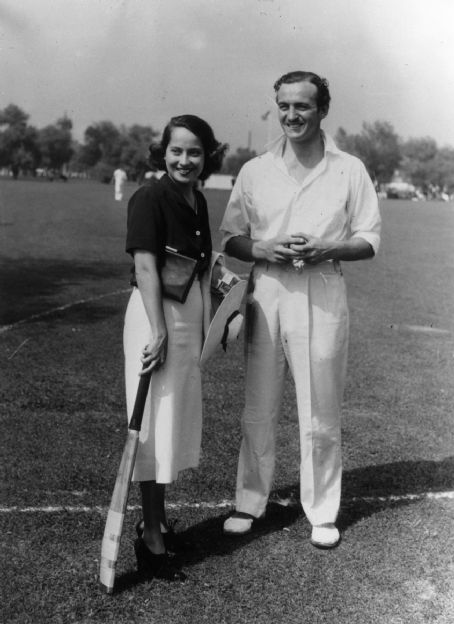
With David Niven


Oberon arrived in England for the first time in 1928, aged 17. Initially she worked as a club hostess under the name Queenie O'Brien and played in minor and unbilled roles in various films. "I couldn't dance or sing or write or paint. The only possible opening seemed to be in some line in which I could use my face. This was, in fact, no better than a hundred other faces, but it did possess a fortunately photogenic quality", she modestly told a journalist at Film Weekly in 1939.


Her film career received a major boost when the director Alexander Korda took an interest and gave her a small but prominent role, under the name Merle Oberon, as Anne Boleyn in The Private Life of Henry VIII (1933) opposite Charles Laughton. The film became a major success and she was then given leading roles, such as Lady Blakeney in The Scarlet Pimpernel (1934) with Leslie Howard, who became her lover for a while.


Oberon's career went on to greater heights, partly as a result of her relationship with and later marriage to Alexander Korda, who had persuaded her to take the name under which she became famous. He sold "shares" of her contract to producer Samuel Goldwyn, who gave her good vehicles in Hollywood. Her "mother" stayed behind in England. Oberon earned her sole Academy Award for Best Actress nomination for The Dark Angel (1935) produced by Goldwyn. Around this time she had a serious romance with David Niven, and according to his authorized biography, even wanted to marry him, but he wasn't faithful to her.


She was selected to star in Korda's film I, Claudius (1937) as Messalina, but a serious car accident resulted in filming being abandoned. Oberon was scarred for life, but skilled lighting technicians were able to hide her injuries from cinema audiences. She went on to appear as Cathy in her most famous film, Wuthering Heights (opposite Laurence Olivier; 1939), as George Sand in A Song to Remember (1945) and as the Empress Josephine in Désirée (1954).


According to Princess Merle, the biography written by Charles Higham with Roy Moseley, Oberon suffered even further damage to her complexion in 1940 from a combination of cosmetic poisoning and an allergic reaction to sulfa drugs. Alexander Korda sent her to a skin specialist in New York City, where she underwent several dermabrasion procedures. The results, however, were only partially successful; without makeup, one could see noticeable pitting and indentation of her skin.


Facial scarring clearly visible


Charlotte died in 1937. In 1949 Oberon commissioned paintings of her mother from an old photograph.  Anxious to conceal her true origins she asked the painter to lighten the colour of Charlottes skin.  The paintings hung in all her homes until Oberon's own death in 1979.

Merle Oberon became Lady Korda upon her husband's knighthood in 1942. She divorced him in 1945, to marry cinematographer Lucien Ballard. Ballard devised a special camera light for her to eliminate her facial scars on film. The light became known as the "Obie" and is still in use today.


She married twice more, to Italian-born industrialist, Bruno Pagliai (with whom she adopted two children; they lived in Cuernavaca, Morelos, Mexico)and Dutch actor Robert Wolders – later companion to actresses Audrey Hepburn and Leslie Caron – before her retirement in Malibu, California, where she died, aged 68, after suffering a stroke. She was interred at Forest Lawn Memorial Park Cemetery in Glendale, California.

Merle Oberon has a star on the Hollywood Walk of Fame (at 6250 Hollywood Boulevard) for her contributions to Motion Pictures.

Michael Korda, nephew of Alexander Korda, wrote a roman à clef about Oberon after her death entitled Queenie. This was also turned into a television miniseries starring Mia Sara.


Oberon claimed that she was born and raised in Tasmania, Australia. The fact that no birth or school records could be found to prove this was explained by another fabrication: all records had been destroyed in a fire. She maintained these fictions throughout her professional life. The story of her alleged Tasmanian connections was comprehensively debunked after her death.

Oberon is known to have been to Australia only twice. Her first visit was in 1965, on a film promotion. Although a visit to Hobart was scheduled, she became ill after journalists in Sydney pressed her for details of her early life, and she left for Mexico shortly afterwards. In 1978, the year before her death, she agreed to visit Hobart for a Lord Mayoral reception. The Lord Mayor of Hobart became aware shortly before the reception that there was no proof she had been born in Tasmania, but went ahead with the reception to save face. However, shortly after arriving at the reception, Oberon denied she had been born in Tasmania, to the disappointment of many. She then excused herself, claiming illness; whether ill or not, this meant she was unavailable to answer any more questions about her background. On the way to the reception, she had told her driver that as a child she was on a ship with her father, who became ill when it was passing Hobart. They were taken ashore so he could be treated, and as a result she spent some of her early years on the island. This story, too, seems to have been a fabrication. During her Hobart stay, she remained in her hotel, gave no other interviews, and did not visit the theatre named in her honour.


Yet there are still many people in Tasmania who claim to have known Oberon as a child. They insist she was the illegitimate daughter of a woman named Lottie Chintock from St. Helens.

Other versions of Merle Oberon's story include:
  • In Hobart in 1978, she pointed to a fine old building and told her husband Robert Wolders she had been born and raised there. The building was in fact Government House, the official residence of the Governors of Tasmania.
  • She left Tasmania for India after her distinguished father died in a hunting accident, and was raised there by aristocratic godparents.
  • Lottie Chintock had been seduced by the owner of the St Helens Hotel, John Wills Thompson.
  • Lottie Chintock gave birth to her in Hobart but was forced to relinquish her.
  • In Hobart, Lottie lived with an Indian silk merchant with the unlikely name of O'Brien. The O'Briens adopted the baby and took her to India, where she grew up.
  • She was taken to India by a travelling troupe of actors called O'Brien.
  • She was taken to India by the cousin of her mother's employer.
  • It is claimed that she attended the Model School in Hobart, but that school has no record of her.


Text Source via Wikipedia